
Rotobrush Air Duct Cleaning in Centennial: A Homeowner’s Guide
Rotobrush is a contact-cleaning system, not a magic wand, and whether it’s right for your Centennial home comes down to two things most homeowners never think to ask about: what your ducts are made of, and what’s actually inside them. The same machine that does excellent work in flex duct can leave fiberglass duct board worse than it found it. This guide explains how the system works mechanically and pinpoints where it genuinely shines and where other methods win. If you’d rather not sort it out yourself, call (855) 337-2063 for a free estimate.
What Is Rotobrush and How Does the System Actually Work?
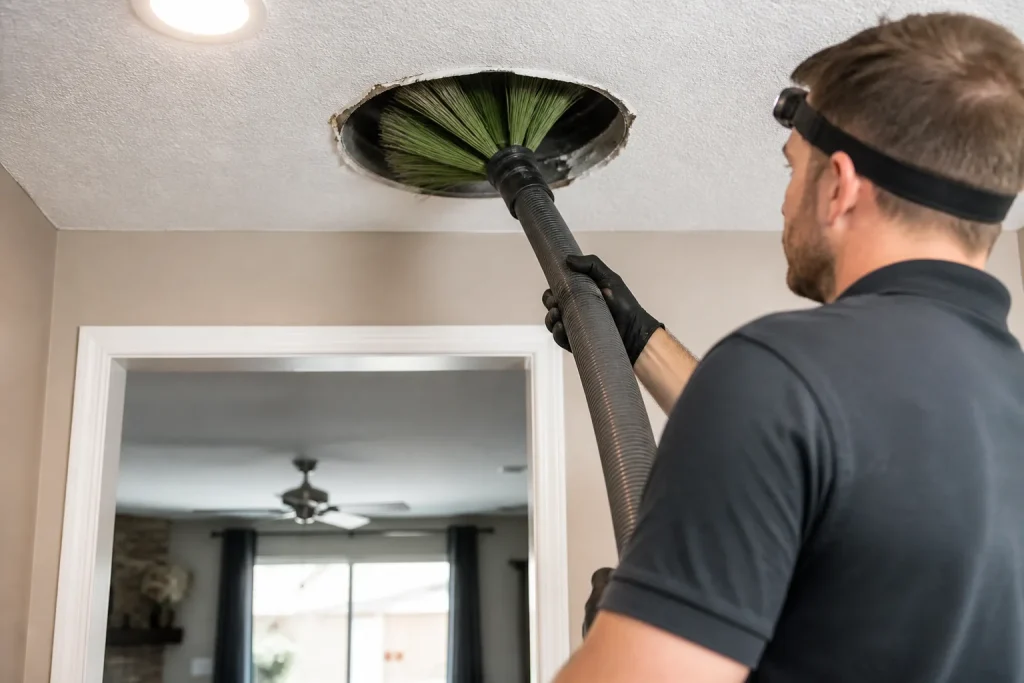
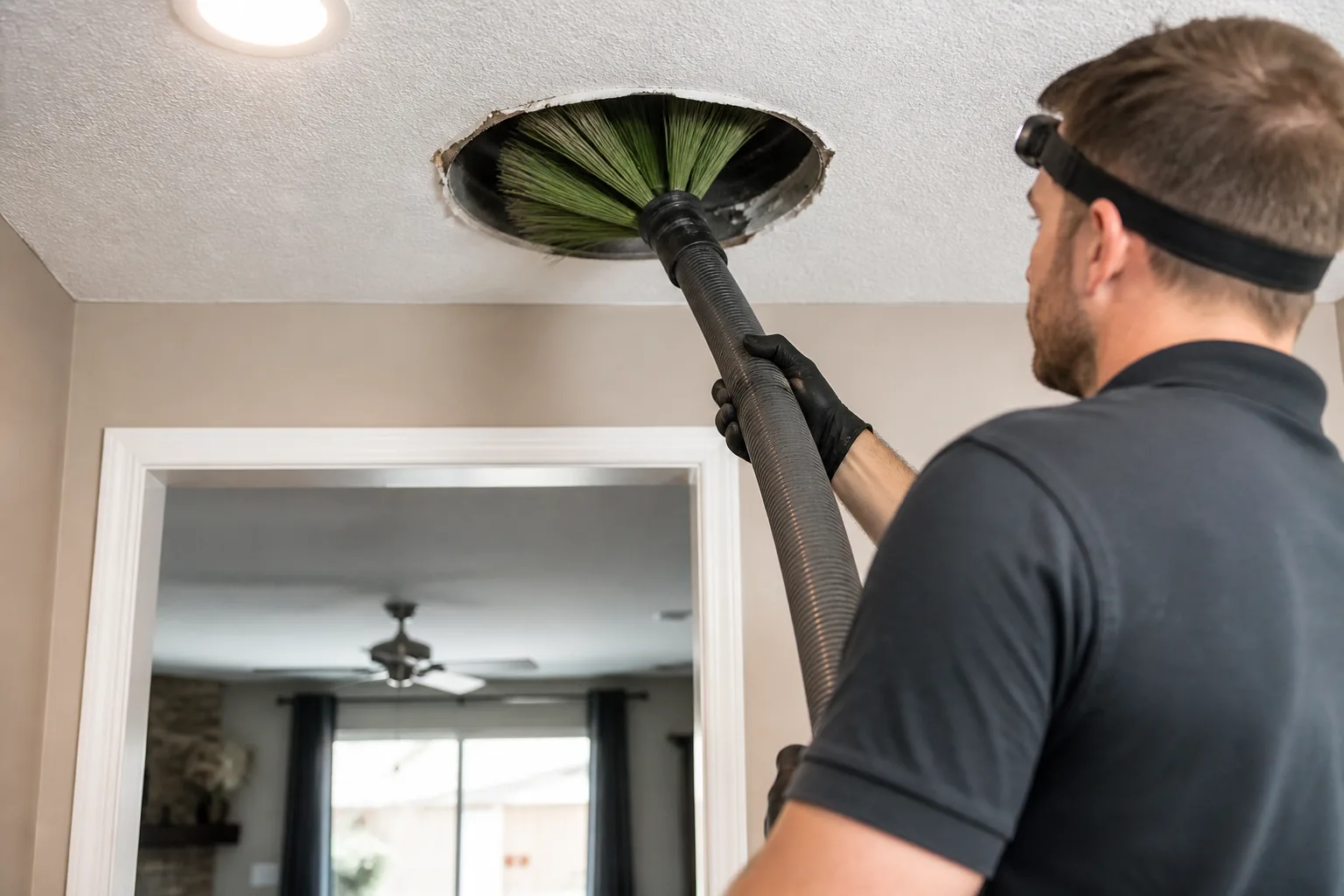
Rotobrush is a contact-cleaning machine: it cleans by physically touching the interior surface of the duct, combining a rotating brush head with a simultaneous vacuum extraction hose running alongside it. The brush loosens debris from the duct wall; the vacuum captures it at the same moment so it doesn’t resettle downstream. Both actions happen inside the duct, in one pass, driven by compressed air through a whip or cable assembly.
That simultaneous agitation-and-extraction design is the whole point. A vacuum alone lifts loose dust off the floor of a duct but leaves adhered film on the walls. A brush alone knocks debris loose without capturing it, pushing contamination further into the system. Rotobrush runs both at once because the two jobs are inseparable in practice.
Mechanically, here’s what happens during a typical pass:
- The technician feeds a flexible whip into a register opening and works it toward the main trunk.
- A rotating brush at the whip’s end scrubs the duct wall as it travels, breaking the bond between debris and surface.
- A high-volume vacuum hose attached along the whip pulls loosened material out of the duct continuously, not in a later pass.
- The technician repeats the run on each branch line, then works the trunk and plenum from access points.
We use professional-grade Rotobrush equipment alongside Nikro systems, the same tier of machinery commercial contractors use. There’s a reason for that: consumer and entry-level machines can’t sustain the airflow needed to capture what the brush loosens. If you’ve ever watched a shop vac choke on drywall dust, you understand the principle.
Which Duct Materials Does Rotobrush Work Well In?
Rotobrush performs well in flexible duct and standard sheet metal, and poorly in unprotected fiberglass duct board. That single distinction explains most of the disagreement you’ll find online about whether the system is any good. It’s not a matter of brand loyalty; it’s a matter of what the brush is touching.
Where it works well:
- Flex duct. The brush follows the corrugated interior and scrubs the ridges where dust collects. Most Centennial homes built in the last few decades have at least some flex runs off the main trunk, and this is where Rotobrush earns its keep.
- Sheet metal trunks and branches. Smooth metal is straightforward. The brush contacts the full interior surface and the vacuum keeps pace, which is exactly the scenario contact cleaning was designed for.
- Mixed systems. A typical house has metal trunks feeding flex branches. A technician can run the same tool through both with an adjustment in head type.
Where it doesn’t:
Fiberglass duct board is the problem child. The interior surface is a compressed fiberglass mat, not bare metal. A rotating brush run across it without liner protection can fray the mat and release glass fibers into the airstream. That’s the opposite of cleaning. Any technician who proposes to brush a duct board system without acknowledging this either doesn’t know the material or hopes you don’t. In those systems, negative pressure methods or non-contact cleaning are the correct call, and a competent technician will say so before touching anything.
Ask what your ducts are made of before you book. It’s the single most useful question in this entire article.
What Contamination Level Is Rotobrush Built For?
Rotobrush is appropriate for routine debris accumulation and insufficient for mold remediation, post-fire soot, or rodent infestations. That’s not a knock on the machine. It’s a contact cleaner built to restore a normally dirty duct to clean, and it does that job well. What it can’t do is turn a contamination problem into a clean surface, because contamination problems need more than scrubbing.
A quick way to think about the tiers:
- Routine accumulation: household dust, pet hair, seasonal debris that settles on duct floors. Rotobrush territory. This is most homes.
- Heavy but ordinary buildup: years of dust without cleaning, light construction residue from a renovation. Rotobrush territory, possibly with a second pass.
- Mold growth: requires an actual remediation protocol, moisture source diagnosis, and often sanitizing treatment with products like those in the Guardsman line. Cleaning alone doesn’t fix mold. You have to fix why it grew.
- Post-fire soot or smoke residue: remediation-level work, not routine cleaning. Abatement Technologies equipment belongs in this conversation, and so does a plan for the whole system.
- Rodent infestation: contamination source removal, sanitizing, and usually duct repair where animals have torn insulation or flex. A brush pass alone leaves the problem in place.
We mention Abatement Technologies for a reason: it signals the toolkit is set up for contamination scenarios, not just surface cleaning. If a company only owns one tool, it will tell you that tool is the answer to everything. It usually isn’t.
How Do You Verify a Technician Is Really Using Rotobrush?
Ask to see the machine before work begins. A genuine Rotobrush system is a distinct piece of equipment, and a technician using one has no reason to hide it. Visually similar knockoffs exist, and “Rotobrush” has become shorthand in the trade for “contact cleaning” rather than a strict equipment description, which muddies things further.
What to look for:
- The machine itself. Ask the name on the unit. Rotobrush and Nikro are the names you’ll recognize in professional contact cleaning.
- The whip and brush head. A contact cleaner uses a flexible rotating assembly. If you see only a vacuum hose being fed into a register, that’s a negative pressure job, not contact cleaning, and the technician should describe it that way.
- Access points. A thorough job creates access in the plenum and trunk. If the technician only works through the floor registers and never opens the main trunk, ask why.
- Camera documentation. Before-and-after photos from inside the duct are standard practice for a professional job now. Ask for them up front. A company that can show you its own before-and-after photos of your ducts is a company that expects to be verified.
On that last point: honest documentation is the whole answer to the bait-and-switch reputation this industry carries. A low teaser price that becomes a much larger invoice once the technician is on site is a real and common frustration, and the cure is one flat price per system, agreed before work starts. No per-vent pricing, no surprise add-ons. If a quote is a number on a postcard with fine print underneath, walk.
What Should a Rotobrush Cleaning in a Centennial Home Include?
A proper Rotobrush job on a typical Centennial home covers every branch line, the main trunk, and the air handler plenum, with camera verification before and after. Scope and duration depend on the size of the system and how dirty it is, but the components of a complete job don’t change much from house to house.
A complete job includes:
- Register-by-register cleaning of every supply and return, including the ones behind furniture (yes, those count).
- Trunk and plenum cleaning through proper access points, not just the branch openings.
- Air handler and blower compartment attention where accessible. If the coil is matted with dust, the ducts aren’t the only problem. Cleaning ducts while ignoring the air handler is like washing a car without touching the wheels.
- Before-and-after camera photos of the actual ductwork, so you can see what changed.
- A written scope and flat price per system, agreed before the technician starts.
Duration varies with system size and contamination level. Some homes are a single focused visit; larger systems or heavier buildup take longer. Any company that quotes a fixed number of minutes over the phone is guessing, and you should hear them say so.
One Centennial-specific note: this part of Colorado sits in a dry, high-plains climate where humidity swings are seasonal and interior air is generally dry most of the year. That dry air tends to keep dust loose and airborne rather than caked to duct walls, which is generally good news for contact cleaning. But the dry climate also means ducts aren’t the only place dust accumulates, and a home’s return-air path is where it collects first. Cleaning the ducts without addressing why debris is getting in is treating a symptom. Duct repair and sealing addresses the root cause: disconnected joints, torn flex, and gaping seams that let attic air and debris into the system.
If the air handler itself needs attention, that’s where HVAC cleaning comes in as a separate step. If your dryer is taking longer than it used to, a lint-choked vent is a different problem with a different fix, handled through dryer vent cleaning. A full-spectrum provider can look at the whole air pathway instead of just one segment of it.
When Should You Call a Pro Instead of Going It Alone?
Call a professional when you can see visible dust blowing out of a register, when family members are experiencing new allergy symptoms indoors, or when the system has never been cleaned and the house is more than a few years old. Duct interiors sit behind sealed access points, and the diagnostic part of this work (camera inspection, material identification, contamination assessment) is not something a homeowner can do from the outside.
There’s a safety side to this too. Air handler compartments contain electrical components and blower assemblies that can cause injury if handled wrong. If you open a panel and see wiring or a control board, close it and call. The technicians who do this work are trained for it, and your furnace isn’t the place to learn.
We don’t position duct cleaning as an emergency. It’s a scheduled, verifiable service, and you should treat it that way. The point isn’t speed. The point is that the work was done properly and you can see the evidence. Our technicians have up to 11 years of experience, and the local professional we connect you with is licensed and insured as their state requires.
For a full look at our entire approach to air duct cleaning in Centennial, start there. If you’re specifically searching for air duct cleaning in the Pinery area, that page walks through the process in detail.
The Bottom Line
Rotobrush is a strong tool for the right home and the wrong one for the wrong home. If your system is primarily flex duct and sheet metal with routine dust accumulation, a contact-cleaning pass with genuine Rotobrush equipment does exactly what you want: it scrubs the duct wall and captures the debris in the same motion. If your ducts are fiberglass board, if there’s mold, smoke, or animal contamination, or if the air handler is a mess, you need more than a brush. You need a provider who will tell you which situation you’re in before anyone touches a register.
Ask what your ducts are made of. Ask what the contamination looks like. Ask for a flat price per system and before-and-after photos. If a company can’t answer those three questions, that tells you what you need to know.
If you’re in Centennial and need help, Air Duct Cleaning Centennial offers free estimates. We answer 24/7, with fast dispatch from 7am to 7pm, Sunday through Friday. Call (855) 337-2063.
Frequently Asked Questions
No. Rotobrush works well in flexible duct and sheet metal, and it’s the wrong tool for unprotected fiberglass duct board or for contamination situations like mold or rodent infestation. The right method depends on your duct material and what’s actually inside the system, which is why a camera inspection before the quote matters.
Pricing is per job by estimate, with one flat price per system agreed before work starts, so you get an exact number for your home rather than a teaser rate. Be wary of unusually cheap quotes. In this trade, a very low advertised price often turns into a much larger invoice once the technician is on site. Call (855) 337-2063 for a free estimate.
You should see before-and-after camera photos of your own ductwork, and you should see the equipment in your home. Ask to see the machine before the job begins. If a company can’t show you its photos or name its equipment, that’s a signal. Call (855) 337-2063 to schedule an inspection and estimate.
Neither is universally better. Contact cleaning like Rotobrush physically scrubs the duct wall, which is an advantage in flex and metal ducts with adhered dust. Negative pressure methods excel in larger commercial systems and certain material types. A good provider matches the method to the duct, not the other way around. Call (855) 337-2063 and we’ll walk you through which approach fits your Centennial home.
Written by the team at Air Duct Cleaning Centennial.
Need Air Duct Cleaning Help?
Call Air Duct Cleaning Centennial - the local pro we connect you with is licensed and insured, here with fast help in Centennial.
(855) 337-2063