
Air Duct Cleaning: Repair or Replace? How Centennial Homeowners Decide
Cleaning deteriorated ductwork without checking its structural integrity first is a lot like detailing a car with a cracked frame. The surface looks better. The problem that determines whether the investment was worth it is still there. In our experience across Centennial, the most expensive duct mistakes we see are cleaning jobs done on ductwork that was already failing behind the drywall.
Repair or replace comes down to whether your duct system can still deliver its designed airflow after the work. Contamination levels matter, but they don’t decide it. If you’d rather not sort that out yourself, call (855) 337-2063 and we’ll walk you through it.
Why Cleaning Is a Separate Question From Repairing
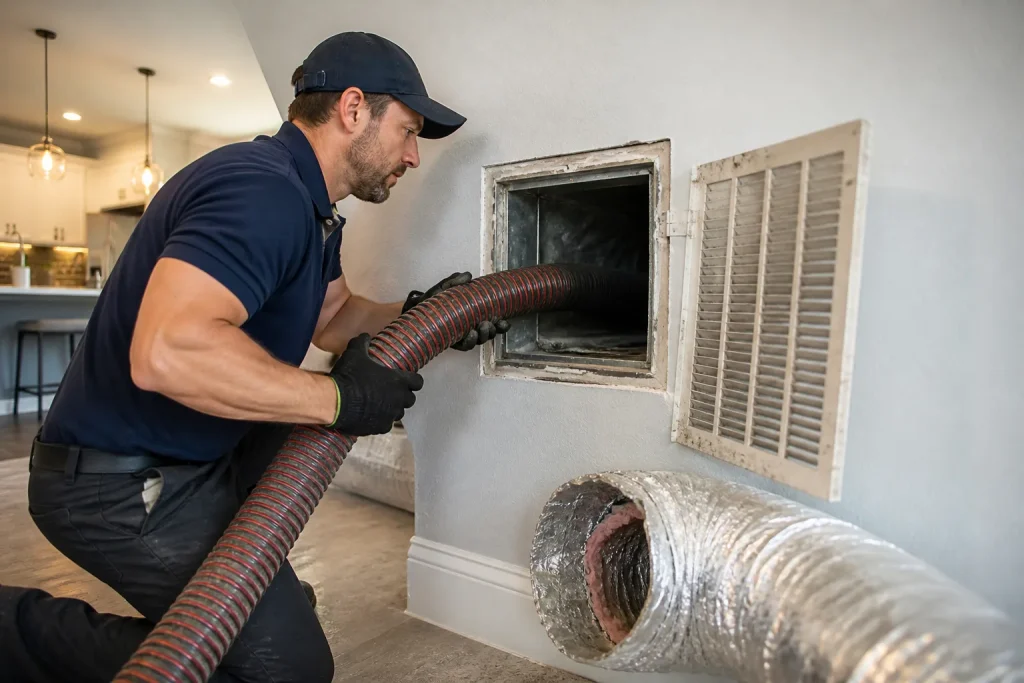
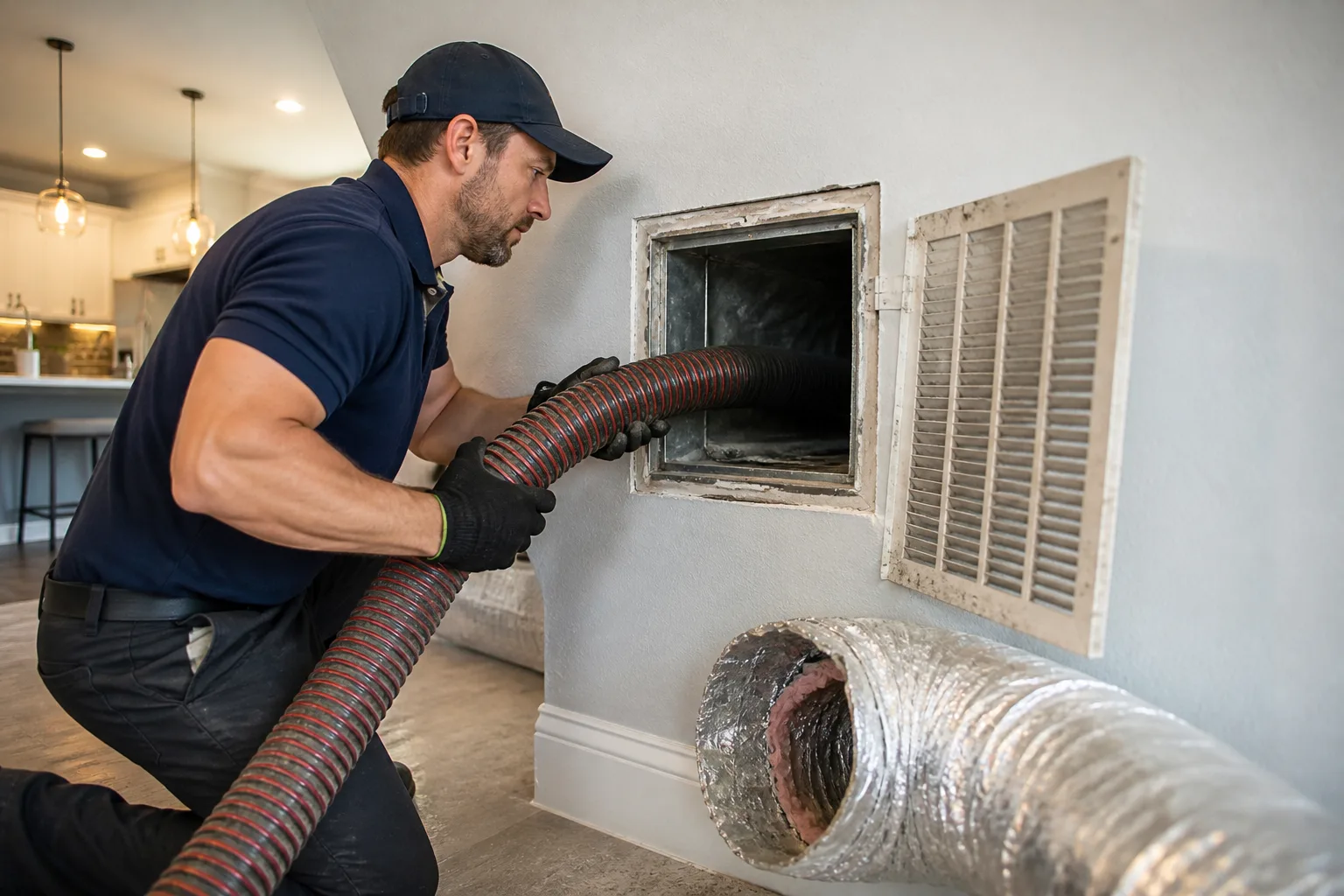
A duct cleaning removes what’s sitting on the inside surfaces: dust, debris, microbial growth, construction leftovers. Duct repair fixes the structure that carries the air. Those are two different problems, and treating one doesn’t solve the other.
We’ve seen Centennial homes where the ducts were cleaned thoroughly and the system still ran wrong. The reason was almost always structural. A run of flex duct that collapsed somewhere in an attic or crawlspace still restricts airflow no matter how clean the liner is. A disconnected trunk line still dumps conditioned air into an unconditioned space. Cleaning around those problems can actually make the situation less obvious, because the ducts look better at every register while the system underneath is still losing air.
That’s why we lead with diagnosis, not a cleaning wand. If you want the cleaning side explained on its own, our page on Air Duct Cleaning Centennial covers what a proper cleaning involves and what it doesn’t.
The right order of operations is: assess structure first, clean second, repair where needed. Sometimes cleaning and repair happen in the same visit. Sometimes the honest answer is that no amount of cleaning fixes a system that needs replacement.
What Duct Work Actually Looks Like Inside
Rigid metal ductwork, well sealed and properly supported, can serve a house for decades with routine cleaning. Flex duct is a different story. It’s the most common duct material in residential construction, and it has a shorter working life than most homeowners assume.
- Liner separation. The inner plastic liner on flex duct can peel away from the insulation and wire coil. Once that happens, air travels through a rougher, collapsing passage and the duct sheds material into the airstream.
- Sagging between supports. Flex duct that wasn’t pulled tight or supported at proper intervals sags. Sag equals restriction, and restriction means the system has to work harder to move the same air.
- Crushed or kinked runs. Sharp bends, tight attic turns, and runs squeezed behind framing collapse the duct’s cross-section. You can’t see it from the register, but the airflow drop is measurable.
- Duct board deterioration. Where duct board was used, the foil facing can fail and the board itself can break down, especially in humid or poorly ventilated spaces.
None of this shows up on a visual check from the floor vents. It shows up when someone gets into the attic, crawlspace, and mechanical closets and looks at how the system was actually built and how it’s holding up.
The Three Conditions That Force Replacement
Most duct problems can be repaired or sealed. Three structural conditions generally can’t, and they decide the question regardless of how dirty the ducts are:
- Collapsed flex duct across more than 20% of the system’s runs. When a fifth or more of the duct runs are crushed beyond recovery, you’re not repairing a system, you’re rebuilding one run at a time. At that point, replacement is the more honest recommendation.
- Failed duct board facing across large sections. Once the facing has failed broadly and the board is breaking down, patching becomes a losing game. The material itself is the problem.
- Disconnected trunk line segments. A trunk line that has separated in an attic or crawlspace is effectively dumping your conditioned air outside the living space. Sometimes this is a straightforward reconnect. When it’s happened in multiple places, or the trunk itself is deteriorated, replacement usually wins.
If your system hits any of those three, cleaning alone won’t fix the airflow. The right move is a repair-and-seal or replacement scope, paired with cleaning afterward.
How a Pressure Test Gives You the Answer
Homeowners in Centennial ask us how to know which way to go, and the honest answer is that you need data, not a guess. The tool for that is a duct blaster test, a pressure test that pressurizes the duct system and measures how much air it leaks.
What the test gives you:
- An objective leakage figure for the whole system.
- A baseline you can compare against after sealing work.
- Evidence of whether the system is losing a small amount of air normally or a large amount through failed joints, disconnected sections, and collapsed runs.
That number is what lets a specialist make a straight repair-versus-replace call. Without it, anyone recommending one over the other is working from a visual inspection and a hunch. A pressure test before and after work is also how you verify the repair actually did something.
Intake is the other half. We use professional-grade Rotobrush and Nikro equipment, the systems contractors rely on for real duct work, because the intake side matters as much as the pressure side. If you want an independent read on the cleaning process, our guide to air duct cleaning covers it.
Repair, Replace, or Both? A Cost Framework
The cost conversation gets honest when you separate spot repair, section replacement, and full system replacement. Your written estimate sets the final number, but these are the bands we see for Centennial homes, including The Pinery area:
- Spot repair and sealing: fixing a disconnected joint or a single failed run. On the lower end of the range.
- Section replacement: replacing a portion of flex duct or a failed duct board section. Mid-range.
- Full system replacement: the highest of the three, but often the better value when the system is broadly deteriorated.
The wrong comparison is cleaning cost versus repair cost. The right comparison is the total cost of getting the system back to designed airflow, including sealing and cleaning. A cheap cleaning on failing ducts is money spent on the wrong problem, and it usually costs more to fix later.
If your ducts are also carrying debris, sealing and cleaning need to be sequenced so the repair isn’t contaminated immediately. That’s where HVAC cleaning and duct repair need to be planned together, not as separate purchases.
What 20-Year-Old Ducts Actually Look Like
Homes built during The Pinery’s main development period often have flex duct that’s now around 20 years old. In our experience, 20-year-old flex duct typically shows liner separation, sagging runs, and joints that were taped and have since given up. Cold snaps and dry air don’t help, and neither do the seasonal temperature swings we get in the Centennial area.
That age changes the math. On a 20-year-old system, a spot repair can be a reasonable stopgap, but full replacement becomes easier to justify when multiple runs are failing at once. Cleaning that system without addressing the structural problems means you’re paying to clean ductwork that’s already on its way out. We’d rather tell you that up front than sell a cleaning that doesn’t hold. For whole-home filtration afterward, we work with Honeywell and Aprilaire systems so the air that does move gets handled properly.
When to Call a Pro
If your ducts are older than 15 years, if the system isn’t heating or cooling evenly, if you notice airflow loss at registers, or if you’re dealing with allergen concerns that haven’t improved after a cleaning, that’s the point to get a structural assessment. A professional can run the pressure test, inspect the runs, and give you a repair-or-replace recommendation with something behind it.
Related services in Centennial: duct repair and sealing, dryer vent cleaning, and air quality and sanitizing handled by one team. Call (855) 337-2063. We answer 24/7. Fast dispatch from 7am to 7pm, Sunday through Friday.
The Bottom Line
- Cleaning fixes what’s inside the ducts. Repair fixes the structure. They’re different problems.
- Three conditions force replacement regardless of contamination: collapsed flex duct beyond 20% of runs, failed duct board facing, disconnected trunk lines.
- A duct blaster pressure test is what actually settles repair-versus-replace. Visual inspections alone don’t.
- Older Centennial homes with 20-year-old flex duct are the most likely to need more than cleaning.
If you’re in Centennial and need help, Air Duct Cleaning Centennial offers free estimates, and a written estimate sets the final price. Call (855) 337-2063.
Frequently Asked Questions
Usually no. Assess structure first, repair or replace where needed, then clean. Cleaning before repair often wastes money because the cleaning gets undone by the repair work.
The common signals are collapsed flex duct across more than 20% of the runs, failed duct board facing, and disconnected trunk lines. A pressure test confirms the answer. Call (855) 337-2063 for an estimate.
Not always, and cheaper isn’t the same as better in this decision. When multiple runs are failing at once, a full replacement is often the better value than repeated repairs. The written estimate sets the final price.
It depends on the system and the home. Homes with allergen concerns or recent renovation often need it sooner. A structural inspection tells you whether cleaning or repair comes first. Call (855) 337-2063 to discuss it.
Written by the team at Air Duct Cleaning Centennial.
Need Air Duct Cleaning Help?
Call Air Duct Cleaning Centennial - the local pro we connect you with is licensed and insured, here with fast help in Centennial.
(855) 337-2063